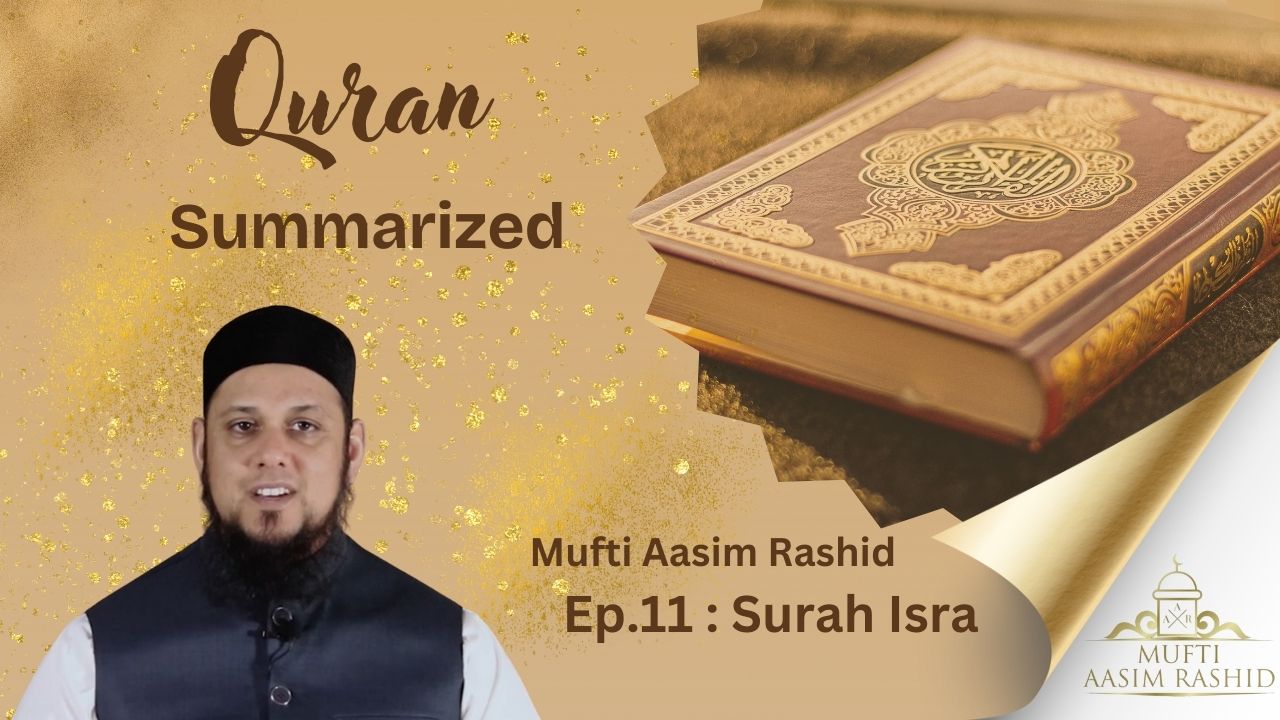
This trip happened directly from Makkah—from the Ka’bah, right by which the Prophet (SAW) used to reside. So, Allah (SWT) says that He took him from Masjid Al-Aqsa—“Aqsa” meaning “distant” or the masjid being the most distant from Makkah.
How did Allah (SWT) take him? Allah (SWT) took him in a miraculous way.
Why did He take him there? There are many reasons. One is that this was the sacred place of all the previous prophets, from the time of Ibrahim (AS) and possibly even before that, all the way up to Isa (AS). This was their sacred place. Prophets grew up in this area and passed away in this area. Many prophets were buried in that region.
So, Allah (SWT) took him to the place of his forefathers, and to meet the whole brotherhood of prophets. Only Allah (SWT) knows how many prophets came—one narration mentions that there were some 120,000, another says 220,000—but we know that there were thousands and thousands of prophets that came from around the world. And Allah (SWT) united them all on that night and had the Prophet (SAW) meet them and lead them in prayer, to express to them and to him that he is not just a prophet, but the leader of all prophets.
The Prophet (SAW) led the salah, and many angels accompanied him. Then, he travelled further.
This masjid, Al-Masjid Al-Aqsa, has its own story and virtues. The Prophet (SAW) used to frequently refer to this masjid. The area surrounding it has also been a cherished land that people go to.
Those of you who studied the story of Yusuf (AS) know that Ya‘qub (AS) was based in that area, and when Yusuf (AS) ended up in Egypt, his family followed him there. Regardless, they were all originally from that land.
Many centuries later, when Musa (AS) would achieve victory over Fir‘awn, with Fir‘awn and his people drowned and Musa (AS)’s people saved, Allah (SWT) commanded him to go back to Bayt Al-Maqdis—to the sacred land, known in the Qur’an as:
“Al-Ard Al-Muqaddasa”
“The sacred land.” (Quran 5:21)
It is a long story, but imagine—Musa (AS) migrating with all of his people all the way back to that land, even though they had already been there once before.
After all that time in Egypt, he takes them back. But what had happened was that the land had been overrun by tyrants, and the followers of Musa (AS)—the Bani Isra’il—did not have the strength or courage to stand up to them, even though the help of Allah (SWT) was with them.
They did not believe it, and they did not have that conviction in their hearts. So, Allah (SWT) punished them by making them lost in the desert for 40 years.
Even in those deserts, Allah (SWT) took care of them, but their entry into Bayt Al-Maqdis was delayed, and during this time, both Musa (AS) and Harun (AS) passed away.
The disciple of Musa (AS), who was with him—Yusha (AS), now a prophet—gathered everyone and said:
“Now we have to go and fight. Allah (SWT) has given me the command, and I will not step back.”
He united them, and they began feeling regret for the decades they had spent in disobedience to Allah (SWT). He said:
“Anyone who has anything else on their mind, go and take care of it now.”
He gave many examples: “I need people who are focused on this one goal.”
His mission, given to him by Allah (SWT), was that in one day, he had to win that battle by ‘Asr, so he needed everyone focused, prepared, and ready to move forward with everything they had.
So, they fought and fought until the time of ‘Asr started coming close.
The time of ‘Asr was coming to an end, and the time of Maghrib was about to start. Yusha (AS) looked up at the sun and said:
“You have your instructions, and I have mine—yours is to set, and mine is to finish this battle, given to me by Allah (SWT).”
So, Allah (SWT) delayed the sun for him so that he could fulfil that commandment, and through this, they conquered the city.
That which could not be done 40 years ago was now completed. But in this process, the people of Bani Isra’il made mistakes and blunders the whole time they were entering the city.
They were given instructions not to touch the wealth accumulated by the enemy, but some people who fought had stolen from it. The instructions were that the people should set the wealth on top of a hill, and Allah (SWT) would send lightning to scorch it to ashes, and that would be a sign that the battle was accepted.
But when they set their spoils on the hill, the fire did not come. So, Yusha (AS) knew that someone had been dishonest.
He gathered the leaders of every tribe to do bay‘ah on his hand, and one of the chiefs’ hands got stuck to his hand.
Yusha (AS) said: “The treachery is from your people. Bring them.”
So, everyone from that tribe came, and then the hands of two people got stuck to Yusha (AS)’s hand again.
Their belongings were searched, and they found so much gold—that these two people had stolen after being told not to—that it was similar in size to a bull’s head.
The gold was returned, and then Allah (SWT) scorched the spoils in acceptance of the battle.
As we go through these incidents, you will see the mistakes that were made—and you will also see that whenever an error or mistake is mentioned in the hadith or Qur’an, it is not to tell us a story for the sake of entertainment.
It is in the hope that we vow and pledge ourselves never to make those kinds of mistakes ourselves.
May Allah (SWT) give us tawfiq.